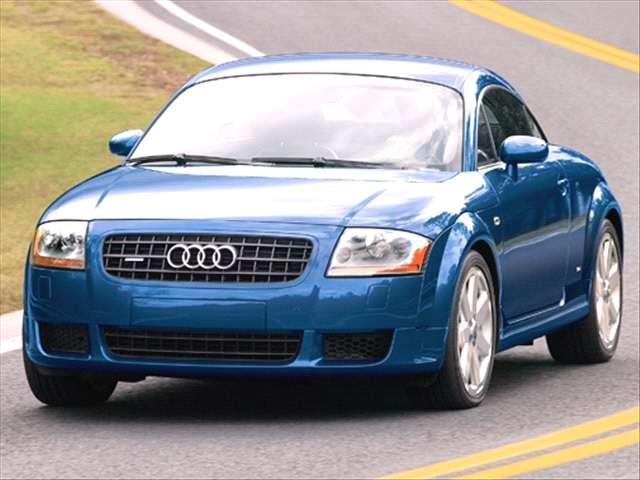
There’s no shortage of options for sporty roadsters, but at the higher end at least, this is a segment that German automakers have had a good handle on for a number of years now. Major players in the affordable teutonic roadster roster are the BMW Z3/Z4, the Mercedes-Benz SLK-Class and this car, the Audi TT.
Based on a platform once shared by the Volkswagen Jetta, Golf and New Beetle, the TT combined common running gear with standout styling that, let’s face it, would look great in most of our driveways.
Initial 2000 TTs used the Volkswagen/Audi group’s corporate turbocharged 1.8-litre four-cylinder engine, tuned to produce 180 horsepower. In 2001, the so-called “225″ model arrived, sporting a 225-horsepower version of the same motor. All-wheel drive became standard in later years, but front-wheel drive versions were available from 2001.
 |
The 2004 model year brought a V6-powered model, which used VW’s narrow-angle, 3.2-litre VR6 engine. In the TT, it made 250 horsepower; this new TT 3.2 – dubbed the TT 250 – became the top-end model, slotting in above the 225-horsepower version. Transmissions were limited to five- and six-speed manual gearboxes up to 2003; from 2004, VW/Audi’s revolutionary (at the time) Direct Shift Gearbox (DSG) sequential six-speed became an option.
Fuel consumption is reasonable thanks to the TT’s smallish engines. Cars with 1.8-litre engines carry Natural Resources Canada consumption ratings of about 11.5 L/100 km in the city and about 7.6 L/100 km on the highway; early 3.2-litre models were rated at about 11 L/100 km in the city and just over 8 L/100 km on the highway.
 |
Despite the TT’s apparent popularity, Consumer Reports has little reliability information on the car. CR points out the timing belt problem and a few others, but the information here is hardly definitive. Audi recommends changing the timing belt at 105,000 miles (about 170,000 km), but several members of the Audi TT Car Club of America say sooner – closer to 60,000 miles (about 100,000 km) is a number that comes up frequently – is better if you want to avoid a broken belt and the kind of severe engine damage that can result from one. There are several discussions about this topic on the web, which can be found here andhere. Want to replace the timing belt yourself? You can find a DIY guide here.
Abnormal temperature gauge readings could be caused by a number of things. If it acts erratically, blame the electronics. A below-normal temperature reading probably means a bad thermostat, and if it reads high, suspect a bad cooling fan(s); this may be accompanied by non-functioning air conditioning.
  |
Non-functional turn signals are caused by a bad flasher unit, which in the TT’s case, is built into the hazard light switch. Depending on who you talk to, a creaking suspension can be blamed on bad control arm or sway bar bushings.
Here’s a cool video from YouTube, demonstrating how the TT’s climate control system can be used to display performance parameters, from vehicle speed to engine coolant temperature.
Here are links to TT frequently asked question (FAQ) pages at Fourtitude.com; AudiTTMKI.com; AudiWorld.comand AudiTTCCA.com.
Safety-wise, the National Highway Traffic Safety Administration (NHTSA) gave the TT five stars in its side impact test, but didn’t put the car through its frontal impact test. The Insurance Institute for Highway Safety (IIHS) didn’t test the TT. Side airbags were standard, as were anti-lock brakes and stability control.
Canadian Black Book says you should be able to buy a used TT for as little as $8,000 for a 2000 model, or spend nearly $30,000 for a 2006 TT 250 Roadster. The turbo four-cylinder engine is all this car needs, even if it isn’t as smooth as the V6; a 2004 225 quattro coupe is worth $17,200.
Overall reliability is only as strong as that of other Audis from the past 15 years, which is to say not great. That said, common problems are well-documented on Audi enthusiast websites and many are easy enough to do on your own; if you’re handy and don’t mind getting your hands dirty, doing routine maintenance and making repairs yourself could help you avoid big mechanics’ bills. And as always, shop carefully: look for a car that comes with service records and passes a once-over by a trustworthy mechanic.

No comments:
Post a Comment